Goa's state solar subsidy, and where it stops
Goa adds its own assistance on top of the central subsidy — substantially more, in fact. But the residential rate is capped at 10 kWp, and that cap is easy to miss.
Tersus Energy2 min read
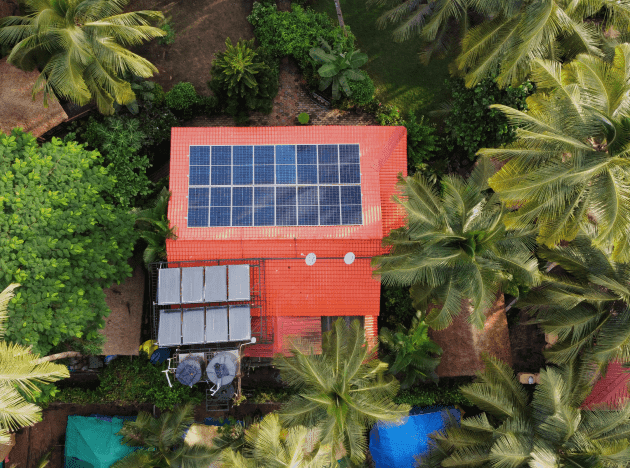
A rooftop system in Goa can draw on two subsidies: the central assistance under PM Surya Ghar, and State Financial Assistance under Goa's Grid-Connected Rooftop Solar Promotion Scheme, administered by GEDA.
The state's share is the larger of the two for anything above a small system, which makes it worth understanding precisely.
The residential rate
State assistance runs from ₹20,000 at 1 kWp to ₹2,20,000 at 10 kWp — and stops there. Ten kilowatt-peak is the ceiling for residential assistance. An 11 kWp system receives the same ₹2,20,000 as a 10 kWp one; a 15 kWp system also receives ₹2,20,000.
This is the detail most often got wrong, including in calculators that extrapolate the per-kilowatt rate past the cap. If you are being shown a state subsidy above ₹2,20,000 on a home system, the number is too high.
Other categories
The scheme covers more than individual homes:
- Group housing societies and residents' welfare associations, and educational institutions: ₹22,500 per kWp, up to 90 kWp
- Commercial and industrial: ₹9,000 per kWp
Stacking the two
For a typical home, the two subsidies are additive: the central ₹78,000 ceiling, plus the state figure for your size. On a 5 kWp system that is a meaningful fraction of the installed cost — and on a 10 kWp system the state's ₹2,20,000 is the larger line by some distance.
What neither subsidy does is change the economics of the kilowatts above the caps. Past 10 kWp, additional capacity is funded entirely by you and repaid entirely by the electricity it generates. That is often still a good trade in Goa, where irradiance is high and the residential tariff rises steeply through the upper slabs — but it is a different calculation, and it should be presented as one.
The scheme window
The current scheme was notified in the Official Gazette, Series I No. 20, dated 13 August 2026, and runs from 1 April 2026 to 31 March 2028. Schemes are revised between windows, so the rates above are the ones in force now rather than a permanent fixture.
Before you commit
Ask your installer for the subsidy split in writing — central and state as separate lines, with the sizes they are calculated against. Two numbers that add up to a plausible total can still hide a state figure that has been extrapolated past the cap, and you will only find out at disbursement.

