How net metering turns your roof into a battery you didn't buy
A grid-tied system generates most of its power when you are least likely to use it. Net metering is the arrangement that stops that being a problem.
Tersus Energy2 min read
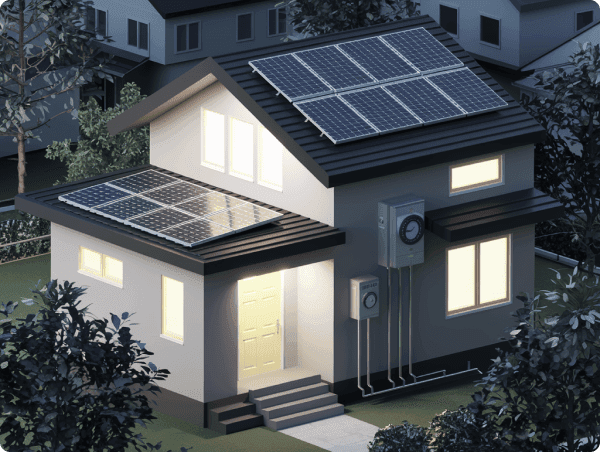
A solar array produces its peak around midday. A household uses its peak in the evening. Left alone, those two curves do not meet, and a lot of generation would simply go to waste.
Net metering is the arrangement that fixes the mismatch without hardware: the grid absorbs what you export during the day and gives it back at night, and your bill is settled on the difference.
What the meter does
A net meter records two quantities rather than one:
- Import — energy drawn from the grid
- Export — energy pushed back into it
You are billed on import minus export. When the two are equal, the energy component of your bill is zero. When export exceeds import, the surplus carries forward as credit against later months.
The practical effect is that the grid behaves like a battery with no purchase price, no degradation and unlimited capacity — but with one important limit: it settles in energy, not in money, and it settles over a period rather than instantly.
Sizing against consumption, not roof space
Because credits offset your own consumption, the natural target is a system that generates roughly what you use over a year — not one that fills the roof. Generating far beyond your consumption builds up credit you may not be able to monetise, depending on how the settlement period ends.
This is where an honest look at twelve months of bills matters more than any rule of thumb about kilowatts per square metre. Seasonal variation matters too: a house that runs air conditioning from March to May has a very different shape to one that does not.
Where batteries still earn their place
Net metering removes the timing problem, but not the outage problem. When the grid goes down, a grid-tied inverter shuts down with it — deliberately, so that it cannot feed a line that a technician believes is dead.
If uninterrupted supply is the point, that calls for a hybrid system with storage. The subsidy schemes are written around grid-tied capacity, so the storage portion is generally funded by you; whether it is worth it depends on how much an outage costs you, which is a question only you can answer.
The three things to confirm
- Sanctioned load. Your system's capacity is normally constrained by it, so check the number on your connection before designing around a size.
- The settlement period, and what happens to unused credit when it closes.
- Who applies. Net metering approval is a process with the distribution licensee, and a competent installer runs it for you rather than handing you a form.
Get those three right and the rest of the system is engineering. Get them wrong and a well-built array can still disappoint.

